
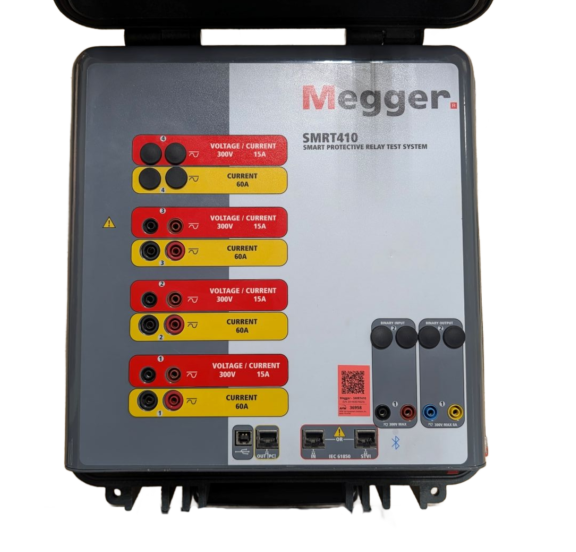
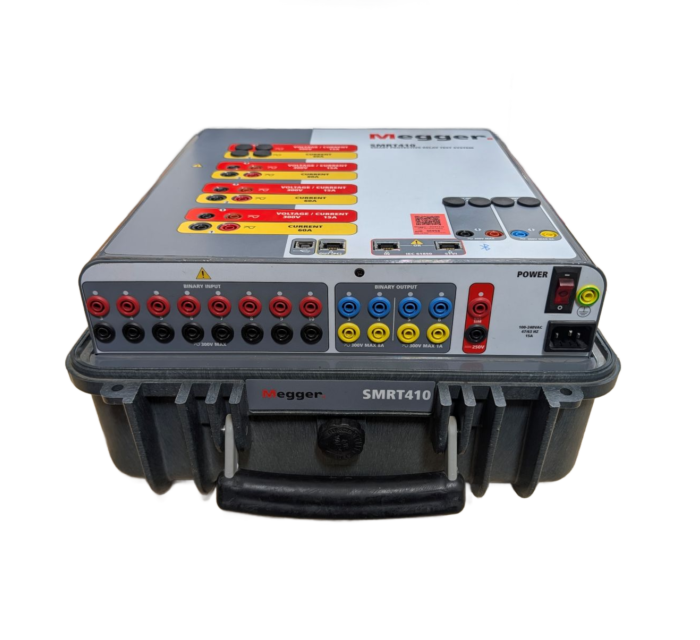

The Megger SMRT410 is a field-portable multi-phase relay test system designed to commission and troubleshoot electro-mechanical, solid-state, and microprocessor-based protective relays.
Convertible Channels: Voltage channels can be converted into current channels, allowing you to test complex setups (like busbar or three-winding transformer differential relays) without constantly re-wiring or moving test leads.
Automated PC Control: Fully compatible with Megger’s Relay Test Management Software (RTMS) for creating, saving, and executing automated test routines from a computer.
IEC 61850 Ready: Fully equipped to test modern digital substations, with built-in capabilities for reading/transmitting GOOSE messages and Sampled Values (9-2 LE).
High-Burden Testing: Capable of generating massive current and power output by paralleling channels, making it highly effective for testing older, high-burden electromechanical relays (like vintage overcurrent relays) alongside modern microprocessor units.
Dynamic Network Simulation: Simulates actual power system events, including reclosing sequences, breaker failure logic, and fault playback.
Base Configuration: Typically configured with up to 4 Voltage channels and 6 Current channels.
Maximum Current Configuration: By converting voltage channels, the unit can provide up to 10 independent current sources.
Single Channel Output: Each individual current channel can output up to 60 Amps at 300 VA.
Paralleled Output: By paralleling three current amplifiers together, it can deliver a combined output of up to 180 Amps at 900 VA.
Binary Inputs: Features 10 programmable binary inputs (used to monitor breaker auxiliary contacts and relay trip signals).
Binary Outputs: Features 6 galvanically isolated binary outputs (used to send breaker status or simulation signals back to the relay).
Communication Ports: Typically includes Ethernet ports for PC connection and IEC 61850 network integration.
Because of its high output power and convertible channels, it can test nearly every generation of protective relay:
Electromechanical Relays: Its high-burden current amplifiers make it highly effective for testing older, high-impedance electromechanical relays that require significant power to operate.
Solid-State & Microprocessor-Based Relays: Easily tests modern digital relays with high precision.


